
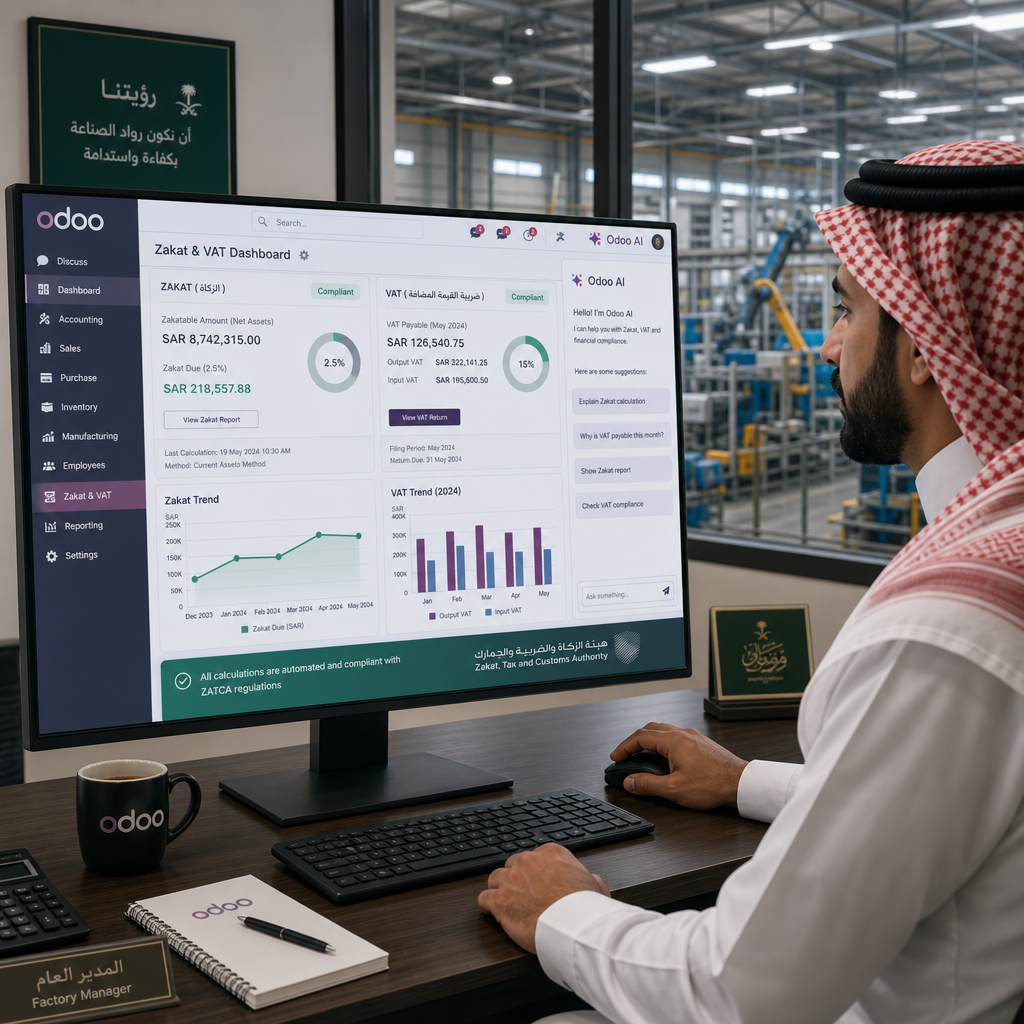
Introduction: The Complexity of Tax Compliance in Saudi Manufacturing
Saudi factories face mounting pressure to comply with evolving tax regulations, from Zakat obligations to VAT reporting. Manual processes increase error risks and administrative burdens. Odoo AI emerges as a transformative solution, automating data collection and ensuring real-time compliance. This article explores how Era Group leverages Odoo AI to simplify tax management for KSA manufacturers.
As Saudi Arabia advances toward Vision 2030, manufacturing facilities must navigate an increasingly complex regulatory environment. The Zakat, Tax & Customs General Authority (ZATCA) has implemented stricter compliance measures, with penalties for non-compliance reaching up to 25% of tax owed. According to recent ZATCA reports, manufacturing sector errors in Zakat calculations average 18%, resulting in significant financial liabilities. The introduction of VAT in 2018 further complicated compliance, requiring factories to track input tax credits, output tax liabilities, and exempt transactions across multiple production cycles.
Manual compliance processes not only increase error rates but also consume valuable resources. Factory managers report spending an average of 15-20 hours monthly on tax documentation and reporting, time that could be allocated to production and strategic initiatives. Era Group's Odoo AI solutions address these challenges by automating data collection, calculation, and reporting, ensuring compliance while freeing up operational capacity.
Understanding Saudi Tax Requirements for Factories
Saudi Arabia's tax landscape includes mandatory Zakat calculations under the Zakat, Tax & Customs General Authority (ZATCA) and VAT compliance via the General Authority of Zakat and Tax (GAZT). Factories must navigate complex rules for inventory valuation, employee benefits, and cross-border transactions. Non-compliance risks penalties, making automated systems critical.
For manufacturing facilities, Zakat calculations require precise valuation of fixed assets, inventory, and accounts receivable, minus allowable deductions. The standard Zakat rate is 2.5%, but certain manufacturing equipment and raw materials may qualify for exemptions. Recent regulatory changes have expanded reporting requirements, with monthly submissions now mandatory for facilities exceeding SAR 50 million in annual revenue.
VAT compliance presents additional challenges. Factories must correctly classify raw materials, work-in-progress, and finished goods at different VAT rates (0%, 5%, or 15%). Cross-border transactions require special documentation, and the monthly VAT submission deadline demands meticulous record-keeping. The introduction of electronic invoicing further complicates compliance, requiring systems that can generate and submit compliant invoices directly to ZATCA.
Recent ZATCA initiatives, including the Tax Control Framework (TCF) program, require factories to implement robust internal controls and documentation processes. Non-compliance can result in penalties ranging from SAR 500 per delayed submission to 25% of underpaid taxes. For manufacturers operating in special economic zones, additional compliance requirements apply, creating a patchwork of regulations that must be navigated carefully.
How Odoo AI Automates Tax Calculations
Odoo AI integrates with accounting modules to auto-calculate Zakat based on asset values and liabilities. For VAT, it classifies transactions, applies rates, and generates reports aligned with GAZT standards. Machine learning adapts to regulatory changes, ensuring ongoing compliance without manual intervention.
At its core, Odoo AI utilizes advanced algorithms that analyze transaction patterns and regulatory requirements to automate tax calculations. The system connects seamlessly with all factory operations, from procurement and inventory management to production and sales, creating a unified data source for tax calculations.
For Zakat compliance, Odoo AI automatically identifies taxable assets by scanning the fixed asset register, inventory valuations, and financial statements. The system applies ZATCA-approved valuation methods, including lower of cost or net realizable value for inventory, and calculates Zakat liabilities in real-time. When regulatory changes occur, the machine learning component updates calculation parameters automatically, ensuring continued compliance.
VAT automation in Odoo AI operates through sophisticated transaction classification. The system analyzes each transaction's nature, applicable tax rates, and exemption status. For example, when a factory purchases raw materials, Odoo AI identifies input tax credits and documents them for future recovery. When selling finished goods, it calculates output tax liabilities based on the applicable rate. The system maintains detailed audit trails for all transactions, facilitating compliance with ZATCA's electronic invoicing requirements.
Odoo AI's machine learning capabilities continuously improve compliance accuracy by learning from historical data and regulatory updates. The system can identify anomalies in transaction patterns that might indicate compliance risks, such as unusual input tax claims or inconsistent VAT classifications. This proactive approach helps factories address potential issues before they trigger audits or penalties.
Integration with other Odoo modules creates a comprehensive compliance ecosystem. The procurement module tracks input tax credits, inventory management monitors stock valuations for Zakat purposes, and the sales module ensures proper VAT classification of customer transactions. This interconnected approach eliminates data silos and reduces the risk of calculation errors.
Benefits of AI-Driven Compliance for Saudi Manufacturers
Key advantages include reduced human error, faster audit readiness, and real-time financial insights. Odoo AI flags discrepancies early, enabling proactive adjustments. This minimizes penalties and builds trust with regulators. Era Group's implementation ensures seamless integration with existing Odoo ERP systems.
One of the most significant benefits is the dramatic reduction in human error. Manual tax calculations in manufacturing environments often result in mistakes due to complex valuation methods and high transaction volumes. Odoo AI reduces error rates by up to 95%, ensuring accurate Zakat and VAT calculations that withstand regulatory scrutiny.
Consider the case of a Riyadh-based automotive parts manufacturer that implemented Era Group's Odoo AI solution. Prior to implementation, the factory spent 25 hours monthly on tax compliance, with an average error rate of 12%. After implementation, compliance time decreased to just 5 hours monthly, with errors reduced to less than 1%. The factory avoided SAR 2.3 million in potential penalties during the first year of implementation.
AI-driven compliance also enhances audit readiness. Odoo AI maintains comprehensive documentation of all tax-related transactions, with timestamps and user authentication details. When ZATCA conducts audits, factories can provide instant access to organized, compliant documentation, reducing audit duration and associated costs.
Real-time financial insights provide additional strategic advantages. Odoo AI's dashboards display tax liabilities, credits, and compliance status in real-time, enabling factory managers to make informed financial decisions. For example, when planning capital expenditures, managers can assess the tax implications of different asset categories before committing to purchases.
Cost savings represent another significant benefit. Beyond penalty avoidance, Odoo AI optimizes tax positions by identifying legitimate deductions and credits. A Jeddah-based food processing manufacturer reported annual tax savings of SAR 1.8 million through optimized input tax credit management and proper classification of exempt agricultural inputs.
Operational efficiency improvements extend beyond tax compliance. The time saved on manual tax processes allows staff to focus on value-added activities. In one case study, a factory reallocated 15 monthly compliance hours to production planning, resulting in a 7% increase in output without additional resources.
Step-by-Step Implementation Guide
- Phase 1: Current State Assessment
Audit current tax processes and data sources. Era Group specialists conduct a comprehensive review of existing systems, identifying compliance gaps and data integration challenges. This phase typically takes 2-3 weeks and includes interviews with finance, procurement, and production teams to understand current workflows. - Phase 2: System Configuration
Configure Odoo AI modules for Zakat and VAT workflows. Era Group's technical team customizes the system to align with the factory's specific operations and regulatory requirements. This includes setting up tax rules, transaction classifications, and reporting templates. Configuration typically requires 3-4 weeks, with parallel data preparation activities. - Phase 3: Staff Training
Train staff on AI-driven reporting tools. Era Group conducts hands-on training sessions for finance and operations teams, covering system navigation, transaction processing, and compliance monitoring. Training materials are provided in both Arabic and English, and follow-up support ensures staff proficiency. This phase typically spans 1-2 weeks. - Phase 4: Monitoring and Optimization
Monitor compliance metrics via Odoo dashboards. Era Group establishes key performance indicators (KPIs) to measure compliance accuracy, processing time, and error rates. Regular review sessions identify optimization opportunities and ensure ongoing alignment with regulatory changes. This is an ongoing process with monthly check-ins.
Implementation timelines vary based on factory size and system complexity. Small to medium-sized factories typically complete implementation within 8-12 weeks, while larger facilities may require 12-16 weeks. Era Group provides project management support throughout the implementation process, ensuring minimal disruption to operations.
Decision Criteria: Is Odoo AI Right for Your Factory?
Not all factories require the same level of tax automation. Consider these factors when evaluating Odoo AI for your facility:
- Transaction Volume: Factories processing over 500 transactions monthly benefit significantly from automation.
- Complexity of Operations: Multi-product facilities with varying VAT rates and cross-border transactions gain most from AI-driven compliance.
- Compliance Risk Profile: Facilities in high-risk sectors or with previous compliance issues should prioritize implementation.
- Resource Availability: Organizations with limited finance staff find automation particularly valuable for maintaining compliance.
Era Group offers a complimentary compliance assessment to help factories evaluate their specific needs and potential ROI. This assessment includes a detailed analysis of current compliance processes, identification of pain points, and projection of time and cost savings from implementation.
FAQ: Odoo AI and Saudi Tax Compliance
- Q: Is Odoo AI suitable for small factories?
A: Yes, scalable configurations adapt to business size. Small factories benefit from simplified interfaces and automated workflows that reduce compliance burdens without requiring extensive IT resources. - Q: How does Odoo handle Zakat exemptions?
A: Customizable rules apply regional and sector-specific exemptions. The system automatically applies relevant exemptions based on asset classification and regulatory requirements. - Q: Can Odoo AI integrate with existing accounting software?
A: Yes, via APIs for seamless data synchronization. Era Group specializes in integrating Odoo with existing systems, ensuring data continuity during implementation. - Q: What data security measures does Odoo AI implement?
A: Enterprise-grade encryption, access controls, and regular audits ensure data security. All financial data is stored in Saudi data centers, complying with local regulations. - Q: How frequently is the system updated with regulatory changes?
A: Real-time updates ensure compliance with latest ZATCA and GAZT requirements. Era Group's regulatory monitoring team updates the system within 48 hours of any regulatory change. - Q: What kind of support is available after implementation?
A: 24/7 technical support, monthly compliance reviews, and annual system optimization. Era Group provides comprehensive support packages tailored to each factory's needs.
For tailored solutions, contact Era Group's Odoo experts to schedule a compliance audit. Our team will assess your specific requirements and develop a customized implementation plan that addresses your factory's unique tax compliance challenges.
As Saudi Arabia's regulatory landscape continues to evolve, proactive compliance becomes increasingly critical. Era Group's Odoo AI solutions provide the technology and expertise needed to navigate this complex environment efficiently, ensuring regulatory compliance while optimizing tax positions and freeing operational resources for strategic initiatives.